Profitable Business, No Cash? Here's What to Do
October 26, 2026

Cash flow management: Do this, not that, when customers take forever to pay.
Congratulations. Your business is profitable.
You've got plenty of work, a good team, and financial statements that would make your accountant smile.
There's just one tiny problem.
Nobody's paying you.
Well, they're paying you. Eventually.
Maybe in 90 days. Maybe 120. Maybe when Mercury is no longer in retrograde.
Meanwhile, your employees have the audacity to expect actual paychecks.
Welcome to one of the most frustrating problems in small business: Being profitable and still running short on cash.

The $750,000 Waiting Game
We recently worked with an established union contractor specializing in commercial interiors, including drywall and painting.
Strong financials. Profitable operation. Steady work.
But the company was getting squeezed by something we've been seeing more frequently among businesses in the trades: customers taking longer to pay.
Invoices that previously took 60 days to collect were stretching to 90.
Ninety became 120.
And some receivables were pushing toward 150 days.
That's five months.
Try telling your employees they'll get paid when your customer gets around to it. See how that conversation goes.
For a union shop with significant labor expenses, those delays can be particularly painful.
The contractor still has to pay wages, purchase materials, and keep projects moving.
So we helped the company secure a $750,000 revolving line of credit to bridge the gap between doing the work and collecting the money.
And there's a lesson here for just about every business owner.
Cash Flow: Do This, Not That.
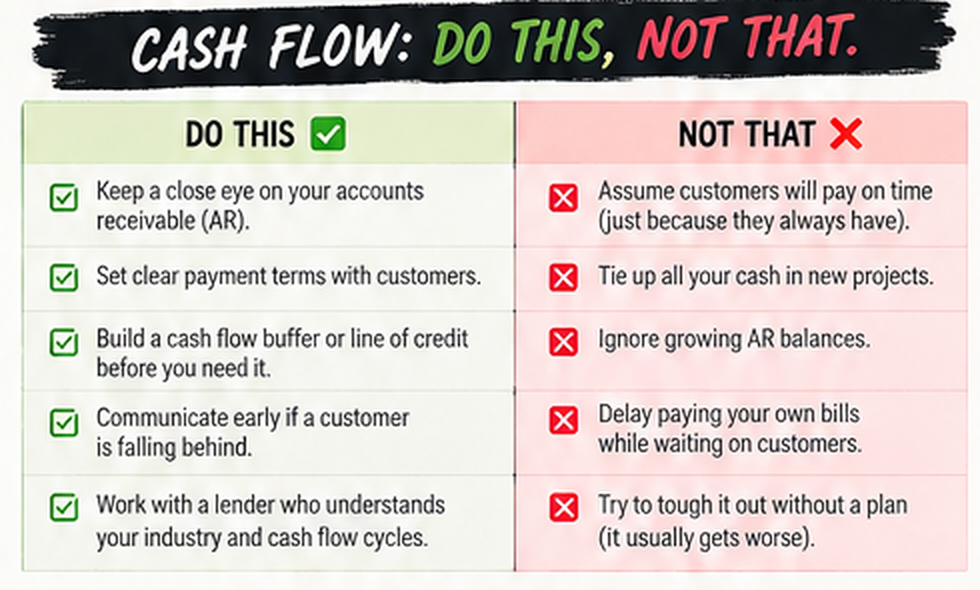
DON'T: Confuse revenue with money in the bank.
DO: Pay attention to accounts receivable.
Revenue tells you how much business you're generating.
Profit tells you what's left after expenses under the applicable accounting method.
Cash flow tells you whether you can actually pay your bills.
Those are three very different things.
A company can report strong profits while having a significant amount of money tied up in unpaid invoices.
That's why you should regularly review your accounts receivable aging report, which shows how much customers owe and how long those invoices have been outstanding.
A growing pile of 90-plus-day invoices isn't a trophy.
It's a warning.
DON'T: Assume customers will pay when they're supposed to.
DO: Build your cash flow forecast around reality.
Net 30 sounds lovely.
Net 30 also means absolutely nothing if your customer routinely pays on day 75.
Your cash flow forecast should reflect when you realistically expect money to arrive, not just when the invoice says it's due.
Consider a contractor billing $300,000 per month.
If customer payments consistently slip an additional 30 days, approximately $300,000 more can remain tied up in receivables at any given time, assuming steady billing and collections.
That's $300,000 you earned but haven't collected.
And unfortunately, your suppliers don't accept "but it's in accounts receivable" as a payment method.
DON'T: Use every dollar you have to fund the next job.
DO: Build a working capital cushion.
Growth costs money.
More jobs mean more labor, more materials, more equipment, and more expenses before you get paid.
If every available dollar is already committed to existing projects, landing another big contract can actually make your cash flow problem worse.
Yes, apparently you can be too successful for your own bank account.
Build reserves where possible, negotiate realistic payment schedules, and understand how much cash you need to cover the gap between expenses and collections.
DON'T: Wait until payroll is in trouble to explore financing.
DO: Understand how a revolving line of credit works.
This is where the contractor's $750,000 line comes in.
A revolving line of credit can work like an accordion.
Draw funds to cover eligible expenses when cash is tight.
As customers pay their invoices, use those collections to pay down the balance.
Then access the available credit again when the next project requires it.
For example:
Borrow $150,000 to cover payroll and materials.
Collect $200,000 from outstanding invoices.
Repay the $150,000 borrowed, plus applicable interest and fees.
Restore borrowing availability for future projects, subject to the credit agreement.
Unlike repeatedly applying for separate term loans, a revolving line can provide ongoing flexibility.
But it still comes with borrowing costs, lender requirements, and repayment obligations. It's a cash flow tool, not a substitute for customers who actually pay.
DON'T: Ignore the problem just because sales look good.
DO: Find out why collections are slowing down.
Financing can help bridge a temporary cash flow gap.
It won't magically fix customers who consistently refuse to pay.
Review overdue invoices. Follow up promptly. Revisit payment terms. Consider deposits or progress billing where appropriate.
And pay attention to customer concentration.
If one large customer represents a huge portion of your receivables, their payment delays can quickly become your problem.
Sometimes the best way to improve cash flow isn't borrowing more money.
It's collecting the money you've already earned.
Not sure how much breathing room your business actually has?
That's a good number to know before your bank balance starts sending distress signals.
Our free Cash Flow Gap Calculator can help you take a closer look at the timing between money coming in and money going out, so you can better understand where a working capital shortfall might be hiding.
The Bottom Line
The contractor in this story didn't need someone to teach them how to run a profitable business.
They already had one.
What they needed was a financing structure that matched how money actually moved through their operation.
The $750,000 revolving line helped provide flexibility while outstanding invoices worked their way through the payment cycle.
Profit is important. But profit doesn't pay payroll. Cash does.
And if your customers are taking longer and longer to pay, don't wait until you're staring at an empty bank account to figure out your next move.
Your Customers Can Take Their Time. Your Business Can't.
Waiting 90, 120, or 150 days to get paid doesn't mean your business should have to sit on its hands.
At Credit Banc, we help business owners explore working capital loans, revolving lines of credit, and other financing solutions designed to help manage cash flow gaps.
Whether you're juggling slow-paying customers, preparing for a big project, or just tired of playing financial Tetris every Friday, it's worth knowing your options.
Schedule a quick call with our team and let's talk about what could work for your business.
Your customers may be dragging their feet. That doesn't mean you have to.