What If Your Business Partner Is Holding the Business Back?
September 14, 2026

In Part 1, we talked about everything you should check before going 50/50 with a business partner.
Credit.
Debt.
Financial history.
Responsibilities.
Exit plans.
All the fun stuff people definitely discuss before signing a partnership agreement.
Except, obviously, plenty don’t.
So what happens when the partnership already exists, and one owner starts creating problems for the business?
That gets trickier.
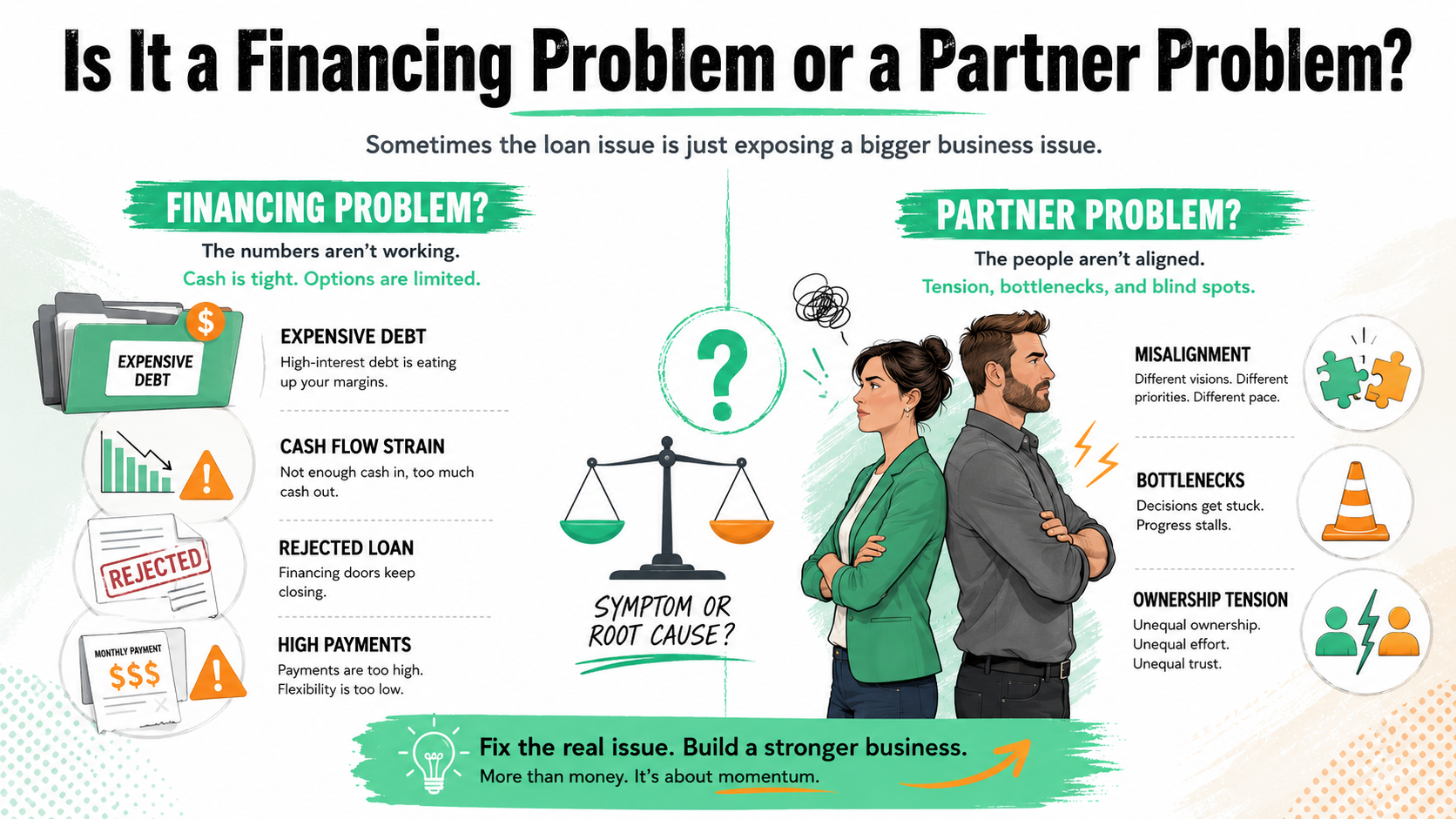
Because sometimes you have a financing problem. Sometimes you have a partner problem. And sometimes the financing problem is just the thing that finally makes the partner problem impossible to ignore.
A Business With a Partner-Sized Problem
Take a trades company we recently encountered.
Two owners.
50/50.
Growing business.
But the company had accumulated roughly $300,000 in debt, including two merchant cash advances and other expensive term financing.
Not necessarily because the business was terrible.
The problem was that whenever they tried to pursue better financing, one partner’s personal financial history kept getting in the way.
His credit profile was significantly weaker. There were previous financial issues in his background. And because he owned half the company, lenders weren’t exactly pretending he didn’t exist.
So the business kept leaning on more expensive options.
That’s problem number one. Then it got worse.
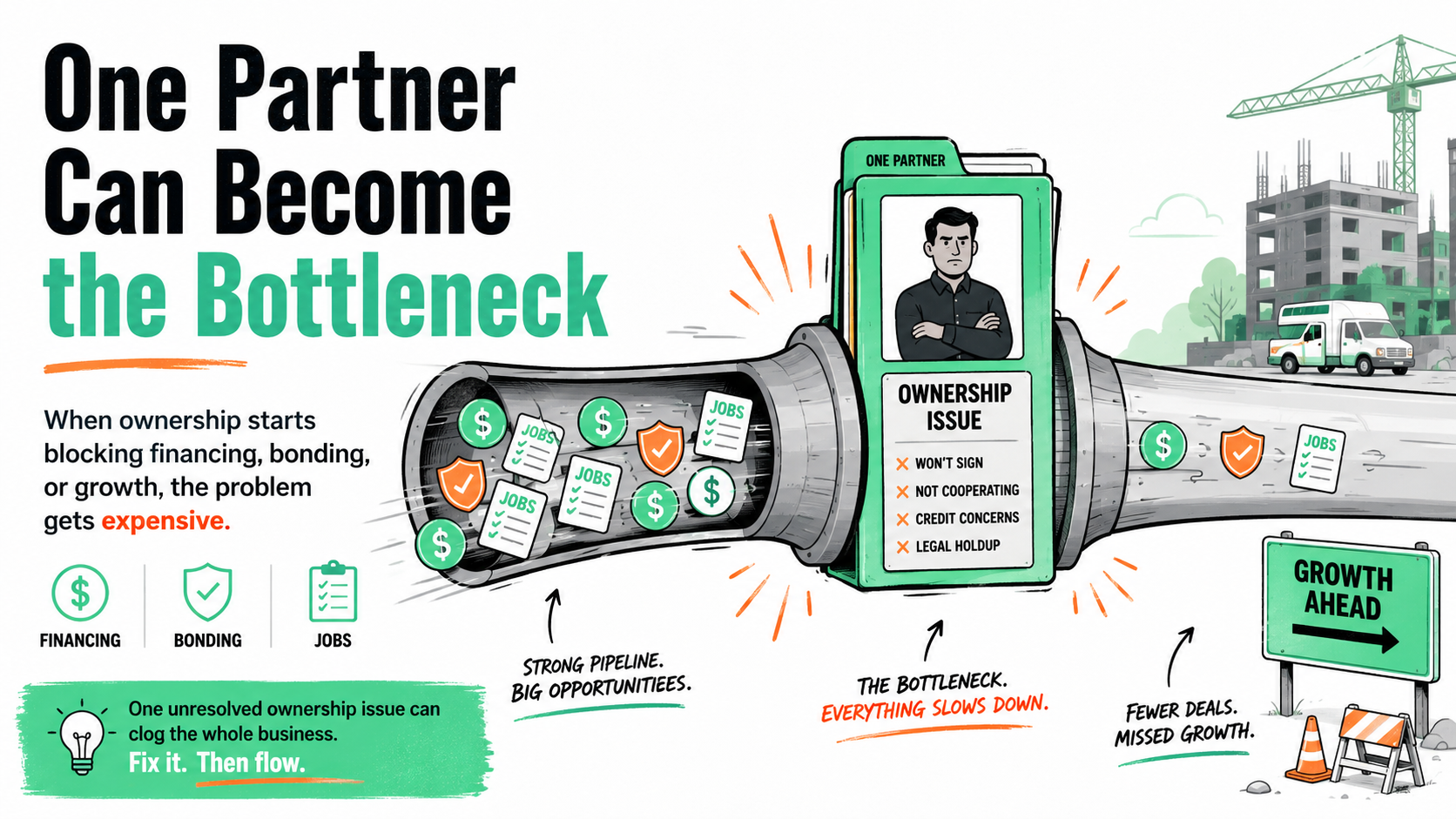
The company pursued a large job that required bonding. The bond was denied because of issues connected to that partner’s background.
Now this wasn’t just about an ugly payment schedule. The partnership was beginning to affect which jobs the company could pursue. That changes the conversation.
When a Financing Problem Starts Becoming a Growth Problem
There’s an important difference between:
“We can’t get the loan we want.”
and:
“We can’t do the things this company needs to do because of our current ownership structure.”
The first may be a financing issue.
The second deserves a much bigger conversation.
In this case, the business had already been dealing with the consequences through higher-cost debt.
Then came the bonding issue.
At some point, you have to stop asking:
“How do we find another lender?”
And start asking:
“Why does this keep happening?”
Not nearly as fun. Considerably more useful.
Ask the Uncomfortable Question
One question cut through the whole situation:
Assume your partner had perfect credit. Would you still want this person beside you as you build the company you’re trying to build?
That’s it. Remove the financing issue entirely.
Forget the credit score.
Forget the debt.
Forget the lender.
Would you still choose this person?
In this particular situation, the answer was no. And suddenly the problem looked very different.
The financing difficulties hadn’t created the partnership problem. They had exposed it.

Is It a Financing Problem or a Partnership Problem?
If your business keeps hitting obstacles connected to one owner, work through this checklist before making any big decisions.
(Because immediately kicking your partner to the curb is generally frowned upon by attorneys, accountants, and probably your partner. Not to mention it’s shitty karma.)
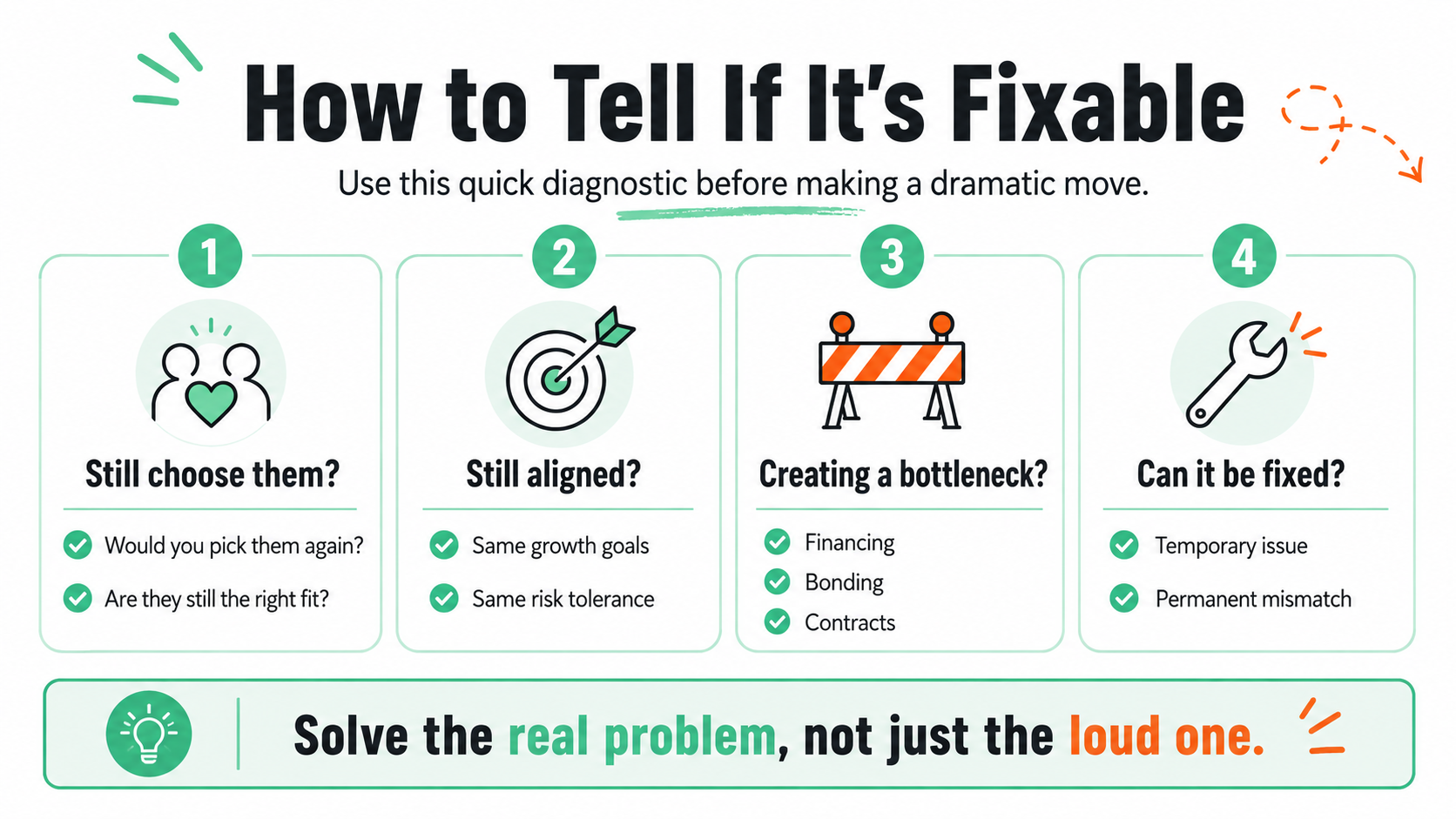
1. Would I still choose this person today?
Forget how long you’ve worked together. Forget whose idea the company originally was. Forget the history. If you were starting the business today, knowing everything you know now, would you choose the same partner?
☐ Yes, absolutely
☐ Yes, but some things need to change
☐ Probably not
☐ I am currently Googling “how to buy out business partner”
That answer tells you quite a bit.
2. Are we still trying to build the same company?
Business partners don’t always grow in the same direction.
One person wants five locations.
The other wants a comfortable living and Fridays off.
One wants to reinvest every dollar.
The other would prefer the company start producing actual money they can take home sometime before retirement.
Neither person is necessarily wrong. But incompatible goals eventually become expensive.
Ask:
☐ Do we agree on growth?
☐ Do we agree on risk?
☐ Do we agree on borrowing?
☐ Do we agree on distributions?
☐ Do we agree on hiring and expansion?
☐ Do we agree on where this company should be in five years?
A 50/50 ownership split gets considerably less charming when the owners want two completely different businesses.
3. Is one owner creating a bottleneck?
This is where the issue becomes more objective. Has one partner’s situation begun interfering with:
☐ Financing
☐ Bonding
☐ Contracts
☐ Licensing
☐ Banking relationships
☐ Vendor relationships
☐ Insurance
☐ Major customers
☐ Expansion opportunities
One isolated problem may be fixable. A pattern deserves attention.
4. Can the underlying problem actually be fixed?
A weak credit profile today doesn’t mean it will remain weak forever.
A tax issue may be resolvable.
Debt can be paid down.
Credit can improve.
Documentation can sometimes be cleaned up.
Financing can sometimes be structured differently.
So ask whether you’re dealing with a temporary obstacle or something structural.
There’s a massive difference between:
“We need six months to clean this up.”
and:
“This ownership structure no longer works for the business we’re trying to become.”
Don’t confuse inconvenient with permanent. But don’t confuse permanent with inconvenient either.
Then Look at the Actual Partnership
Financial performance isn’t the only thing that matters. Ask what each partner currently contributes. Not what they contributed six years ago. Today.
☐ Revenue
☐ Customers
☐ Industry expertise
☐ Licensing
☐ Management
☐ Operations
☐ Sales
☐ Relationships
☐ Capital
☐ Leadership
☐ Strategic direction
Businesses evolve.
The ownership structure that made perfect sense at $500,000 in revenue may make considerably less sense at $5 million. That doesn’t automatically mean somebody needs to leave. It does mean the conversation is worth having.
If Someone Does Leave, Don’t Wing It
In the trades-company example, the owners ultimately discussed transferring one partner’s shares to the other.
That changed the borrower profile dramatically and opened up financing possibilities that hadn’t previously been available.
But that is not a DIY Friday-afternoon project.
Ownership transfers can affect taxes, liabilities, guarantees, company agreements, debt, licensing, and plenty of other things that become spectacularly unfun when handled incorrectly.
Before changing ownership, bring in the appropriate attorney, accountant, financial professionals, and anyone else relevant to the company’s financing or licensing.
Your operating agreement should also tell you what happens when an owner exits. If it doesn’t? Congratulations. You just discovered another item for the to-do list.
Don’t Let the Wrong Problem Distract You
Business owners are problem solvers.
That’s normally useful.
But it can also keep you solving the wrong problem for far too long.
Can’t get financing? Find another lender.
Payments are too high? Refinance.
Can’t get bonded? Try another provider.
And sometimes those are exactly the right answers.
But when the same underlying issue keeps popping up, it may be worth asking whether you’re treating symptoms instead of the actual problem.
Sometimes you need different financing.
Sometimes you need to repair something inside the business.
And sometimes you need to have a very uncomfortable beer with your business partner.
Nobody puts that one in the startup pitch deck.