Before You Go 50/50, Check the Other 50
September 7, 2026

Going into business with someone is a little like getting married.
Except instead of arguing about whose family you’re seeing for Thanksgiving, you get to argue about payroll, debt, taxes, hiring, contracts, and who approved the $14,000 equipment purchase nobody remembers discussing.
Romantic.
Most people know they should vet a potential business partner.
Can they do the job?
Do they know the industry?
Can they sell?
Do they have the right licenses?
Will they actually show up on Monday morning?
All important.
But there’s another category that tends to get skipped because it makes everyone slightly uncomfortable: Money.
Specifically, their money.
And that can come back to bite the business in the ass later.

Your Business Partner’s Financial History Doesn’t Stay Personal
We recently heard about a growing trades business with two equal owners.
The company needed capital to keep growing, but whenever it tried to improve its financing options, one partner’s personal financial history created problems.
So the business did what a lot of businesses do when the best financing options aren’t available.
It took the options that were available. That meant:
More expensive debt.
Shorter-term financing.
Higher payments.
Eventually, the issue went beyond borrowing. A bonding problem became another warning that one owner’s financial baggage could affect the company’s ability to pursue certain opportunities.
That’s when an uncomfortable question became unavoidable:
Was this still the right partnership for where the company wanted to go?
That’s a much bigger question than, “What’s your credit score?”

Bad Credit Doesn’t Automatically Mean Bad Partner
Important distinction here.
Someone having a bankruptcy, credit problems, old tax issues, or another financial setback doesn’t automatically make them irresponsible, dishonest, or somebody you shouldn’t do business with.
Shit happens.
Businesses fail. Divorces happen. Medical bills accumulate. People make mistakes. Occasionally the economy decides to throw everyone down the stairs at once.
The problem is not necessarily the baggage.
The problem is finding out about the baggage after you’ve already handed someone 50% of the company.
Business partner due diligence is about understanding what each person brings into the partnership, good and bad, before those things start affecting decisions.
Don’t think of it as conducting an interrogation; you just want to eliminate any surprises.
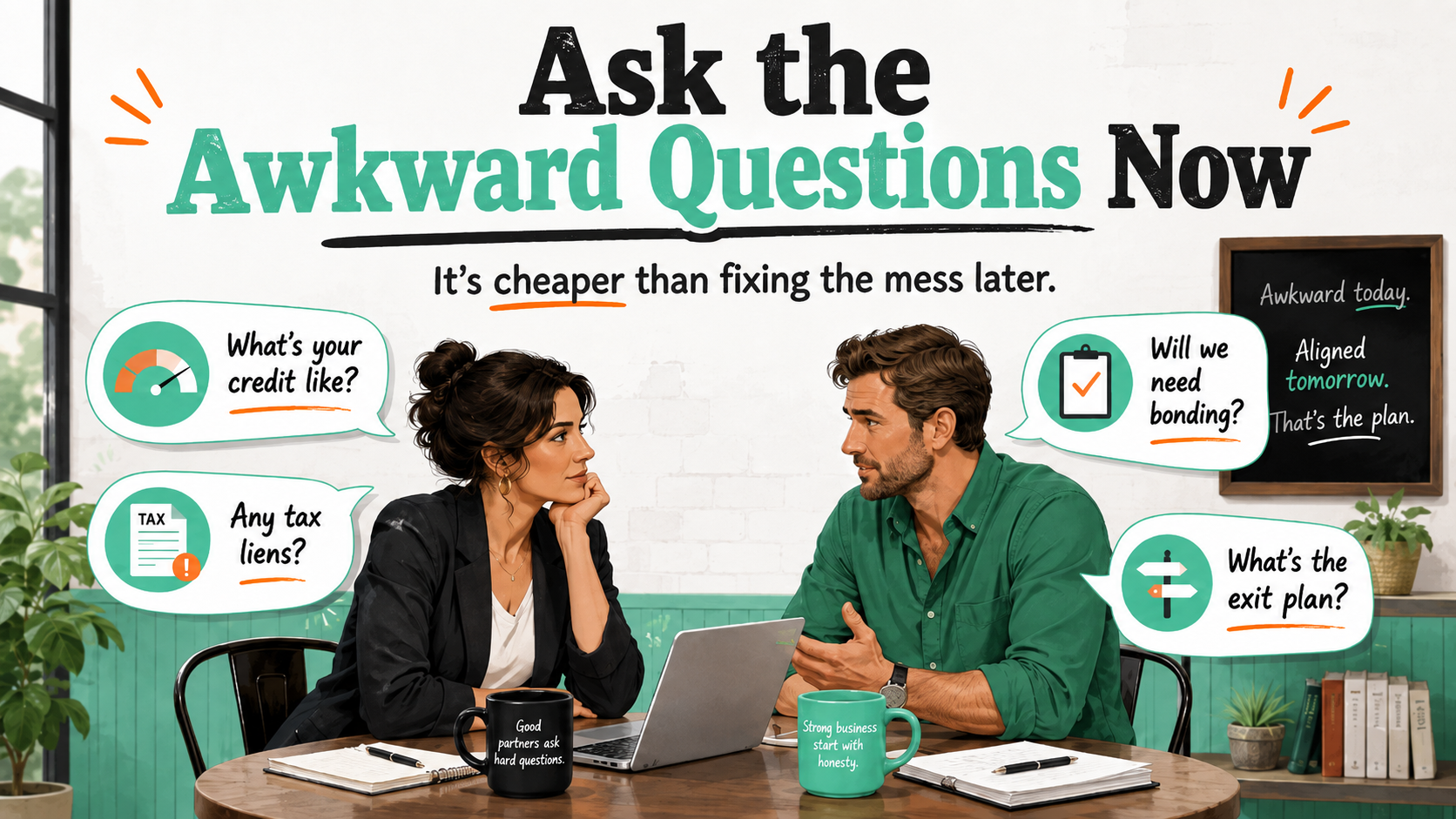
Before You Get Between the Sheets, Check the Sheets
There’s really no elegant way to ask someone you’re excited to start a company with:
“So, before we order business cards, how financially screwed are you?”
(Maybe don’t phrase it exactly like that.)
But you do need the conversation.
Here’s a business partner due diligence checklist worth working through before ownership gets finalized.
Personal financial picture
Discuss:
☐ Personal credit history and significant credit issues
☐ Previous bankruptcies
☐ Tax liens or unresolved tax obligations
☐ Judgments or other major liabilities
☐ Existing personal guarantees
☐ Business debts they’re already responsible for
You don’t need a partner with a spotless financial history. You need an accurate one.
Financing expectations
Talk about how the business expects to use financing.
☐ Will you need working capital?
☐ Equipment financing?
☐ Commercial real estate financing?
☐ Business lines of credit?
☐ Bonding for larger contracts?
☐ Will owners need to personally guarantee debt?
If outside capital is part of the growth plan, understanding potential obstacles before you need the money is considerably more pleasant than discovering them while payroll is staring at you.
Ownership and responsibilities
Then there’s the fun part. What exactly is each partner bringing to this relationship?
☐ Cash
☐ Industry experience
☐ Customers
☐ Licenses
☐ Equipment
☐ Relationships
☐ Operational expertise
☐ Sales ability
☐ Management responsibility
Two people owning 50% of a company doesn’t necessarily mean they contribute 50% of everything. Know what the deal actually is.
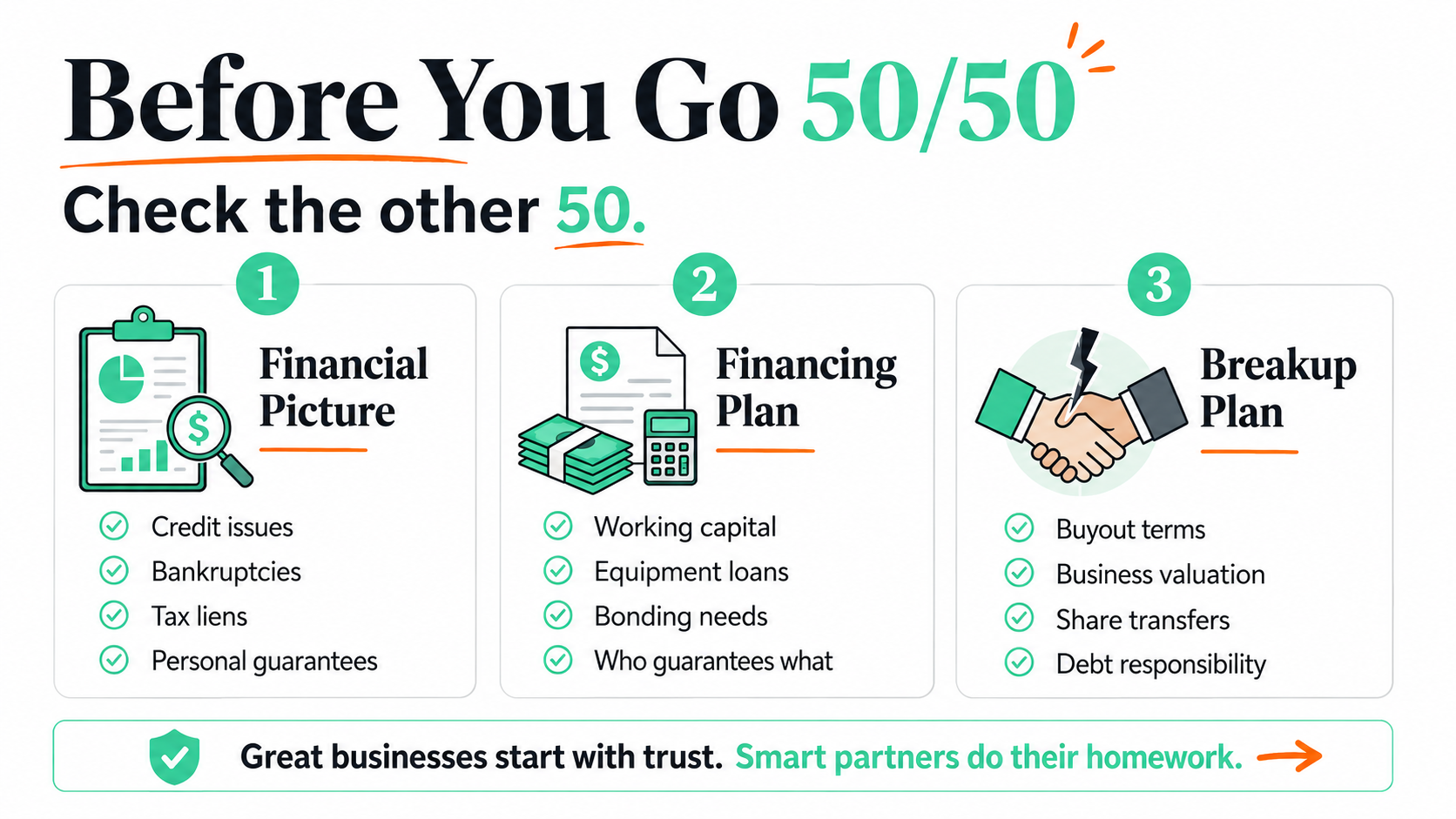
And Then Talk About the Breakup
Nobody wants to discuss how a partnership ends while they’re starting one.
Do it anyway.
Before starting the business, work with the appropriate legal and financial professionals to answer questions like:
☐ Can one partner buy out the other?
☐ How will the business be valued?
☐ What happens if a partner stops working in the business?
☐ What happens if someone dies or becomes disabled?
☐ Can shares be transferred to somebody else?
☐ What happens to personally guaranteed debt?
☐ What happens if one owner creates a financial problem for the company?
☐ Who has authority to take on new debt?
☐ What financial information must partners disclose?
Ask One More Question
There’s one question we especially like because it cuts through everything else:
Assume your prospective partner had perfect credit and plenty of money.
Would you still want this person beside you five or ten years from now?
If the answer is yes, financial issues may simply be obstacles the two of you need to understand and plan around.
If the answer is no?
That credit report may have just helped expose a much larger problem.
Due Diligence Isn’t Distrust
Talking about personal finances before starting a business can feel awkward.
So can talking about equity.
Or compensation.
Or decision-making authority.
Or what happens if someone wants out.
That doesn’t mean you skip it.
A good business partnership requires transparency precisely because so much is riding on it.
You’re combining money, risk, responsibility, reputation, and probably a significant chunk of your waking life.
Check the experience.
Check the references.
Check the licenses.
Check whether they’re actually someone you want to spend 50 hours a week solving problems with.
And before you go 50/50?
Check the other 50.