Business Debt Consolidation Loans: When It Makes Sense
October 5, 2026

Business debt has a funny way of multiplying.
One credit card covers an equipment repair. A line of credit gets you through a slow month. Another loan handles inventory. Before long, six different payments are wandering through your bank account like they all pay rent there.
That’s when a business debt consolidation loan may be worth a look.
The basic idea is simple:
Use one new loan to pay off multiple existing business debts.
If the numbers work, you could end up with:
Fewer payments to manage
A more predictable monthly payment
Better cash flow
A longer repayment term
Potentially better financing terms
But consolidation isn’t financial Febreze.
Moving debt around only helps if the new structure is actually better.
When Does Business Debt Consolidation Make Sense?
A business debt consolidation loan may be worth exploring if:
You’re juggling several loans, credit cards, or lines of credit
Daily, weekly, or multiple monthly payments are squeezing cash flow
Your credit or business financials have improved since you originally borrowed
You want to replace expensive revolving or short-term debt
You’re preparing for a sale, retirement, transition, or another major move
The goal isn’t merely to turn five payments into one because one is a nicer number.
The goal is to leave the business in a stronger position.
Real Example: $125,000 to Clean Up Business Debt
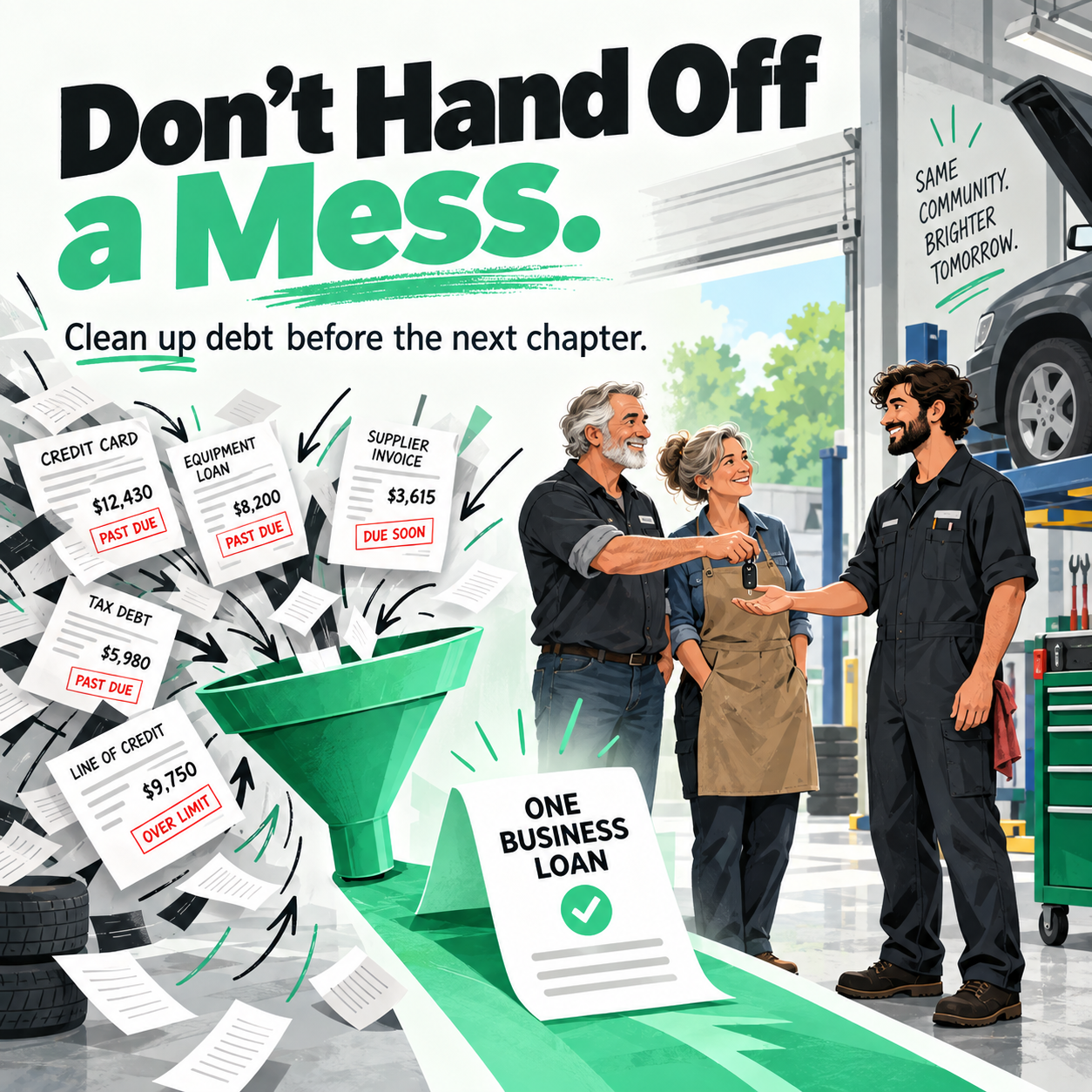
One recent Credit Banc client was an automotive repair shop in Illinois.
The owners, a husband-and-wife team in their upper 60s, were beginning to think about stepping away from day-to-day operations and transitioning more responsibility to one of their mechanics.
The problem?
The business was carrying:
Significant credit card debt
An expensive revolving line of credit
They didn’t want to hand over the keys along with a complimentary pile of expensive debt.
So Credit Banc helped arrange a $125,000 conventional term loan to consolidate what they were carrying.
Why This Deal Mattered
This wasn’t some glamorous expansion story.
No ribbon cutting or 14-location rollout or someone posed beside a forklift with their arms crossed.
They simply wanted to get the business financially cleaned up before moving into the next chapter.
And that matters.
Sometimes financing is about growth.
Sometimes it’s about fixing the stuff that makes growth, retirement, succession, or even a decent night’s sleep harder than it needs to be.
What Business Debt Can You Consolidate?
Depending on the lender and program, consolidation may be available for debts such as:
Business credit cards
Business lines of credit
Existing term loans
Certain short-term loans
Merchant cash advances
Other qualifying business debt
Before doing anything, get the actual numbers.
For each debt, know:
Current balance
Monthly, weekly, or daily payment
Interest rate or financing cost
Remaining term
Current payoff amount
Any prepayment penalties
What If Your Credit Score Is the Problem?
Here’s where things get more interesting.
Sometimes the smartest financing move is:
Don’t borrow yet.
Not exactly the slogan you expect from a funding company, but occasionally patience beats speed.
Another recent Credit Banc client owned an accounting firm.
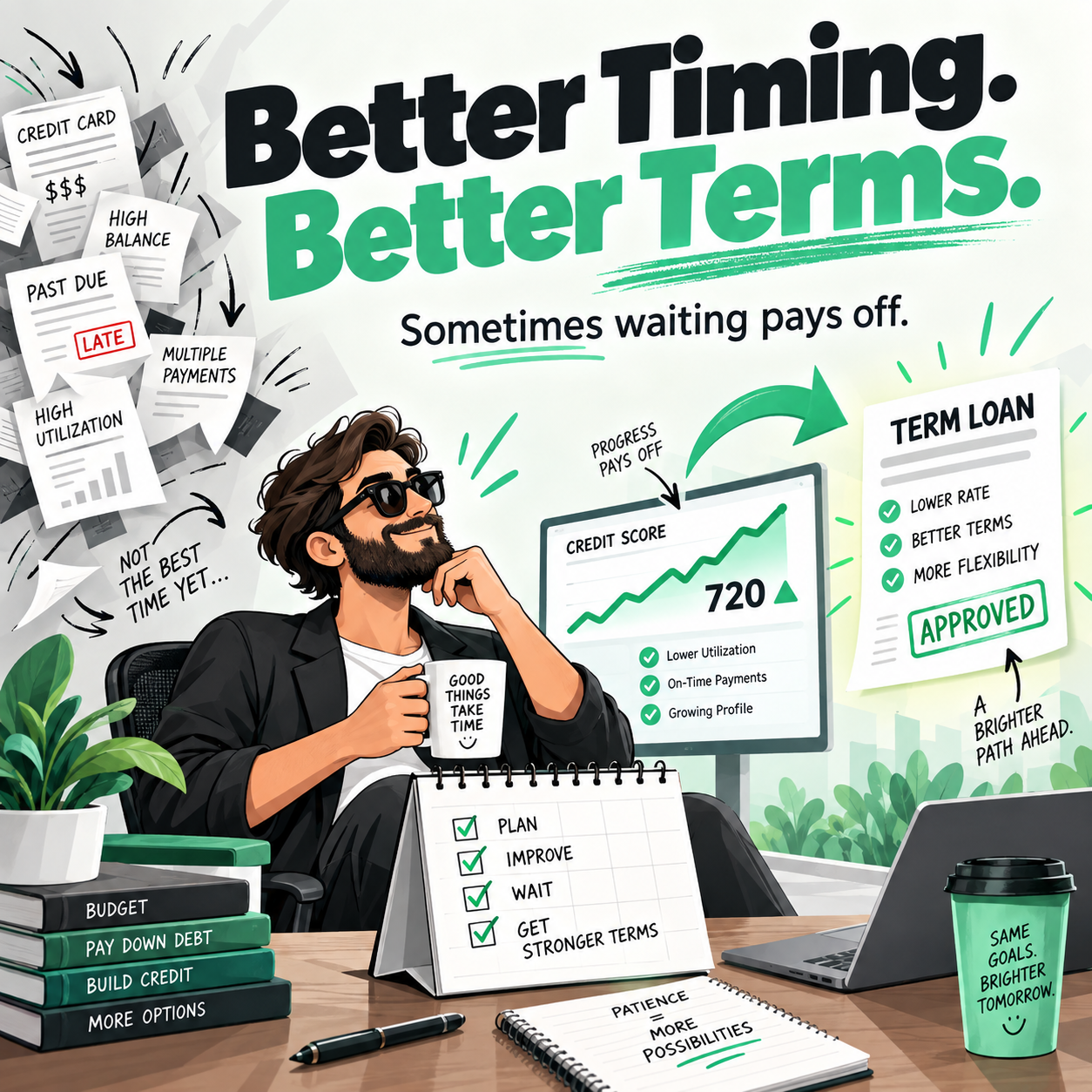
When he first came to us, his FICO score was around 645–650.
But he didn’t necessarily have a history of terrible credit decisions.
He had high revolving credit utilization.
That distinction matters.
After reducing his revolving balances, his reported credit score climbed to around 720 within roughly a month.
Instead of pushing him into whatever financing he could qualify for immediately, Credit Banc advised him to wait.
Then he obtained a $250,000 term loan.
The financing gave him room to:
Consolidate some existing debt
Add working capital
Hire another accountant
Invest in new software
The Lesson: Better Timing Can Mean Better Options
This does not mean everyone can knock down a few balances and magically gain 70 credit-score points by next Tuesday. Credit profiles are individual, after all.
The useful takeaway is this:
Your borrowing position can change.
If your credit, cash flow, revenue, or debt picture is likely to improve soon, it may be worth asking whether applying today actually makes sense.
Sometimes the best deal available right now isn’t the best deal you could qualify for 30 or 60 days from now.
5 Things to Check Before Consolidating Business Debt
Before replacing existing debt, compare the whole deal.
Not just the shiny number at the top.
1. What Are You Paying Now?
Add up every debt payment leaving the business.
Monthly. Weekly. Daily. (Especially daily.)
Death by a thousand cuts is still death, even if each cut is conveniently ACH’d before breakfast.
2. What Would the New Payment Be?
Will the new loan create meaningful breathing room?
A lower payment can help cash flow considerably. But if you’re saving $200 a month and extending the debt until your grandchildren take over the company, perhaps keep looking.
3. What Will the New Loan Cost Overall?
Compare:
Interest rate
Loan term
Total repayment
Origination fees
Closing costs
A lower monthly payment can still mean paying more over the life of the loan.
That doesn’t automatically make it a bad decision.
Cash flow has value.
Just know the tradeoff before signing something with 47 pages and suspiciously small print.
4. Are There Payoff or Prepayment Penalties?
Existing financing may charge you for paying it off early.
Yes, occasionally lenders get annoyed when you return their money too soon. Finance is full of charming little traditions.
Know those costs before calculating your savings.
5. What Problem Are You Actually Trying to Solve?
This may be the most important question.
Are you trying to:
Lower monthly payments?
Improve cash flow?
Eliminate high-cost debt?
Replace daily or weekly payments?
Free up working capital?
Prepare for retirement or succession?
Simplify the balance sheet?
If you don’t know what success looks like, it’s pretty hard to tell whether the new loan accomplished anything.
One Payment Isn’t the Goal
Business debt consolidation can make life simpler.
That’s useful.
But simplicity isn’t enough.
The real question is:
Does the new financing leave the business better off?
For the auto repair shop, better meant cleaning up debt before transitioning the business.
For the accounting firm, better meant waiting until the owner was in a stronger borrowing position, then using financing for both consolidation and growth.
Two completely different businesses.
Same basic idea.
Funding should fit what the business is trying to accomplish. Not the other way around.

Carrying Multiple Business Debts?
If your business has credit cards, lines of credit, loans, or other financing pulling cash in different directions, it may be worth taking a closer look at the structure.
Credit Banc can review:
What you owe
What you’re paying
What those payments are doing to cash flow
What you may qualify for
Whether restructuring the debt actually makes sense
Because “just get another loan” is not a strategy. Let’s figure out whether there’s a better way to structure what you already have.
Prequalify in under 2 minutes. 🔗 Get started here.
Financing is subject to lender approval and qualification. Loan amounts, rates, terms, eligibility requirements, and funding timelines vary by applicant and lender. Case studies reflect specific client situations and do not guarantee future results.