
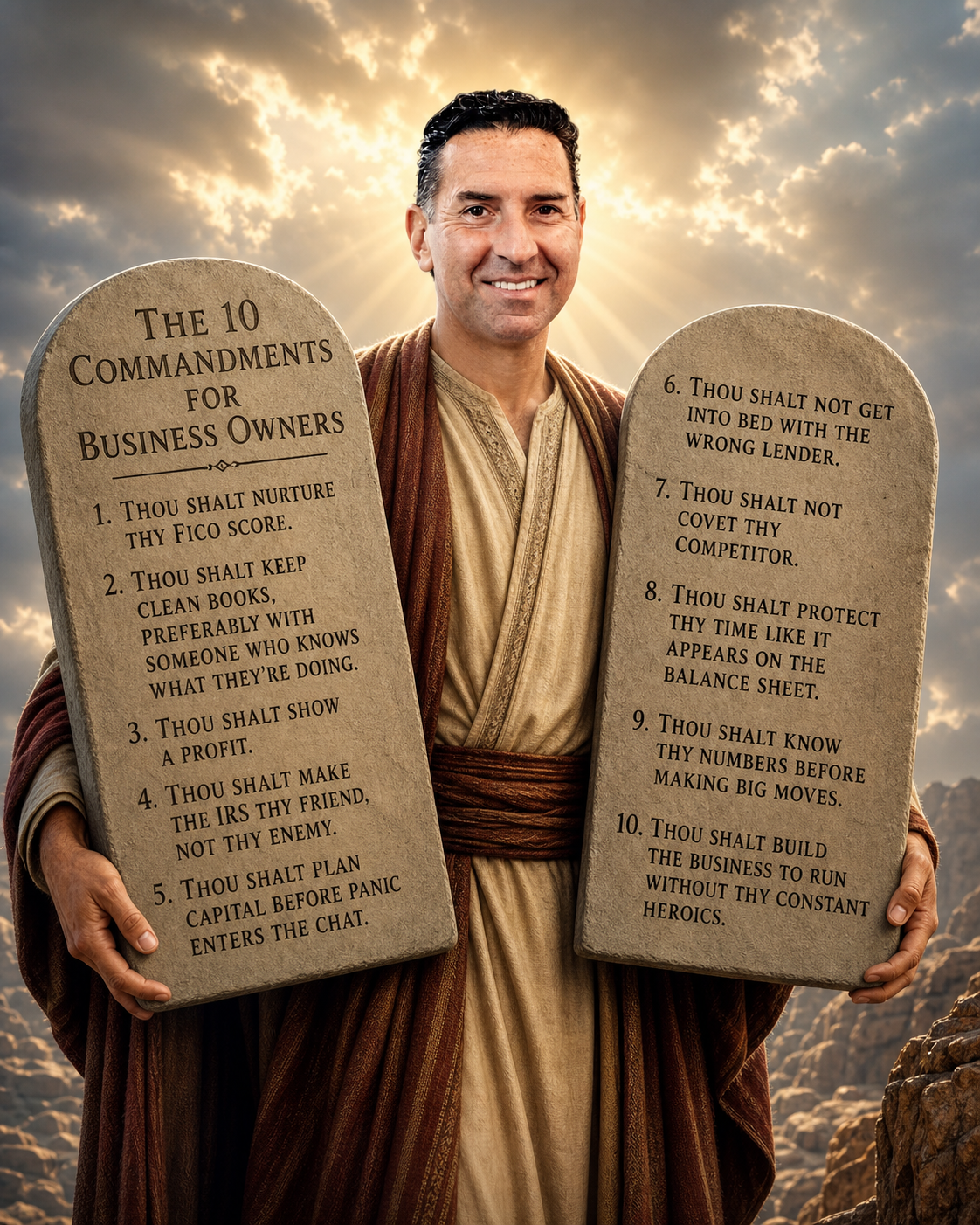
The 10 Commandments for Business Owners Who Want to Stay in Business
Most business advice sounds like it was written on a hotel conference room whiteboard by someone who owns too many vests.
“Follow your passion.”
“Dream bigger.”
“Work smarter.”
“Believe in yourself.”
Lovely. Truly. Put it on a mug.
But if you own a small business, you already know belief does not reconcile bank statements, pay the IRS, fix cash flow timing, clean up bad debt, train employees, or stop you from answering emails at 10:47 p.m. while questioning every decision that led you here.
Running a business takes more than motivation. It takes discipline. Boring, useful, unsexy discipline. The kind that keeps your company from turning into a very expensive group project held together by caffeine, crossed fingers, and one person who “just knows where everything is.”
That is where these commandments come in.
No stone tablets. Just ten rules small business owners should probably follow if they want to build something healthy, fundable, profitable, scalable, and less likely to make them mutter curse words in a parking lot.
Let’s begin.
1. Thou shalt nurture thy FICO score.

Your credit matters before you need funding, not after.
A lot of business owners treat personal credit like something they will “deal with later,” which is adorable in the same way ignoring a check engine light is adorable. Your credit profile can affect financing options, rates, approvals, leases, vendor terms, credit cards, and other business opportunities.
Even if your business is established, your personal credit may still walk into the room and start speaking on your behalf.
And if it says, “This person has been using personal credit cards like a business line of credit with vibes-based repayment,” that conversation may get ugly fast.
What to do about it:
Monitor your credit regularly.
Keep credit utilization as low as possible.
Pay on time, every time.
Review your credit report for errors.
Avoid mixing personal and business expenses.
Do not use personal credit cards as your long-term business funding plan.
Build business credit where possible, but do not ignore personal credit in the process.
Your FICO score is not your personality. Thank God. But it is part of your financial reputation, and business owners need to treat it like something that matters. Because it does.
2. Thou shalt keep clean books, preferably with someone who knows what they’re doing.

Clean books are not just for tax season.
They are how you understand what is actually happening inside your business.
Messy books make everything harder. Pricing decisions get fuzzy. Profit gets blurry. Expenses hide in weird little corners. Tax prep becomes a scavenger hunt. Funding conversations get slower. Planning turns into guesswork. Selling the business someday becomes a nightmare with spreadsheets.
You cannot make strong decisions with weak numbers.
And no, checking your bank balance every morning does not count as financial management. That is just emotional roulette with a login screen.
What to do about it:
Reconcile accounts every month.
Separate business and personal transactions.
Review your profit and loss statement regularly.
Look at your balance sheet, not just revenue.
Track accounts receivable and accounts payable.
Hire a real bookkeeper or accountant before the mess becomes archaeological.
Use accounting software consistently.
Schedule a monthly financial review, even if it makes you mildly cranky.
Clean books give you visibility. Visibility gives you control. Control gives you better decisions.
Not glamorous, but hella useful.
3. Thou shalt show a profit.

Revenue is nice.
Profit is better.
Revenue is the number people like to brag about. Profit is the number that tells the truth after payroll, rent, software, inventory, materials, debt payments, taxes, contractors, insurance, marketing, and seventeen subscriptions nobody remembers approving.
A business can have impressive revenue and still be financially fragile. Busy does not mean healthy. Growth does not mean profitable. A packed calendar does not mean the business is winning. Sometimes it just means you have built a very complicated machine that turns effort into exhaustion.
At some point, the business has to prove it can actually make money.
What to do about it:
Know your gross profit margin.
Know your net profit margin.
Review pricing at least once a year.
Identify your most profitable products, services, jobs, or clients.
Identify the work that keeps everyone busy but barely makes money.
Track labor, materials, overhead, and delivery costs.
Stop worshipping revenue if profit is limping behind it.
Build profit goals into planning, not just sales goals.
Profit gives your business oxygen. It helps you hire, invest, expand, repay debt, survive slow periods, and sleep like a person who does not have 11 browser tabs open about business bankruptcy at midnight.
Remember: Revenue gets attention. Profit keeps the lights on.
4. Thou shalt make the IRS thy friend, not thy enemy.

The IRS is not a vendor you can ignore until they get bored.
They do not get bored. They get penalty-happy.
Taxes, payroll filings, estimated payments, documentation, deductions, compliance, and entity structure all matter. Not because they are thrilling. (They are not.) But because tax problems have a special gift for becoming expensive at the worst possible time.
Unpaid taxes can also affect financing, business sales, real estate deals, acquisitions, and your general ability to enjoy being alive.
The IRS does not need to become your unofficial business partner. Nobody wants that.
What to do about it:
Track filing deadlines.
Make estimated payments when required.
Stay current on payroll taxes.
Keep documentation for deductions.
Do not use tax money as operating cash.
Talk to a CPA before tax season, not during the annual panic parade.
Open a separate account for tax reserves.
Respond to IRS notices immediately instead of hiding them under other papers like a cursed treasure map.
Taxes are not optional. Planning for them is cheaper than pretending they are someone else’s problem. Spoiler: they are not.
5. Thou shalt plan capital before panic enters the chat.

Working capital should help your business move with intention.
It can help you buy inventory, take on larger jobs, bridge timing gaps, hire, expand, upgrade equipment, cover receivables, or move faster when opportunity shows up.
What it should not be is the thing you scramble for after cash gets tight and every option suddenly looks expensive, rushed, and suspiciously shiny.
When business owners wait until they are desperate, they usually have fewer options, less leverage, and more pressure to accept terms that may not actually fit.
Panic is a terrible financial advisor.
What to do about it:
Build a 90-day cash flow forecast.
Know your slow seasons and busy seasons.
Identify upcoming expenses before they become urgent.
Keep financial documents updated.
Decide what capital would actually be used for before looking for it.
Compare repayment terms, not just approval amounts.
Understand whether the business can handle the payment.
Talk through options while you still have room to think.
Planning capital ahead of time does not mean you have to borrow. It means you are not making major decisions with your hair on fire. And that is generally preferred.
6. Thou shalt not get into bed with the wrong lender.

Fast money can be useful.
Fast money can also become a cash flow cage match if the terms are ugly.
Daily payments, weekly withdrawals, short repayment windows, stacked advances, confusing fees, and aggressive structures can create pressure quickly. The approval amount might look exciting, but the repayment structure is where the real story lives.
A bad financing decision does not just cost money. It can limit options, squeeze cash flow, create dependency, and turn every week into a financial obstacle course.
Read the structure, not just the approval.
What to do about it:
Ask how often payments are made.
Understand the total repayment amount.
Review the term length.
Know whether payments are daily, weekly, or monthly.
Ask what happens if revenue dips.
Compare multiple options when possible.
Avoid signing under pressure.
Work with people willing to explain the tradeoffs without treating questions like an inconvenience.
The right lender should help you understand the decision. The wrong one just wants your John Hancock, fine print be damned.
7. Thou shalt not covet thy competitor.

Your competitor’s business is not your business.
Their trucks, staff, office, revenue claims, website, social media posts, equipment, expansion plans, and dramatic LinkedIn updates do not tell the whole story.
You do not know their margins. You do not know their debt. You do not know their payroll pressure. You do not know whether that shiny new location is making money or quietly draining the life force from its balance sheet.
Copying competitors without understanding your own numbers is how business owners end up buying problems they did not need.
Their highlight reel is not your business plan.
What to do about it:
Track your own margins before chasing someone else’s growth.
Know which parts of your business are actually profitable.
Compare strategically, not emotionally.
Study competitors for positioning, service gaps, and market trends.
Do not expand just because someone else did.
Do not buy equipment, hire staff, or add services to keep up appearances.
Make decisions based on your numbers, your customers, and your goals.
Competition can teach you things. It should not run your company by remote control.
8. Thou shalt protect thy time like it appears on the balance sheet.

Your time has value. Not theoretically. Not in a motivational poster way.
Literally.
Every hour you spend fixing avoidable issues, answering the same question, chasing the same missing document, doing low-value admin, or handling tasks someone else could handle is time not spent leading, selling, improving, training, planning, or building.
Small business owners often protect cash more carefully than time, which is strange because wasted time has a nasty habit of becoming wasted money.
You are not supposed to be the human junk drawer for every task nobody else wants to own.
What to do about it:
Track where your time actually goes for one week.
Identify tasks only you can do.
Identify tasks someone else should do.
Delegate recurring low-value work.
Document repeated processes.
Set boundaries around meetings, calls, and interruptions.
Use automation where it genuinely reduces friction.
Stop confusing availability with leadership.
Being busy is not the same thing as being effective. Sometimes, the most profitable move is getting yourself out of tasks you should not have been doing in the first place.
9. Thou shalt know thy numbers before making big moves.

Expansion. Hiring. Equipment. Acquisitions. Bigger contracts. New locations. New services.
All useful.
And all risky AF when the math is fuzzy, and the plan is mostly crossed fingers.
Big moves require more than excitement. They require numbers. Cash flow projections. Cost estimates. Break-even analysis. Debt service calculations. Staffing needs. Timeline assumptions. Worst-case scenarios. Boring stuff that saves you from expensive surprises.
A business owner who knows the numbers can move with confidence.
What to do about it:
Calculate the true cost of the move.
Estimate best-case, realistic-case, and worst-case outcomes.
Know the break-even point.
Review how the decision affects cash flow.
Include taxes, payroll, insurance, maintenance, and hidden costs.
Understand how long it may take to see a return.
Make sure the business can survive delays.
Get outside advice before making a major commitment.
Growth is not automatically good. Bad growth can be expensive AND distracting. Know the math before you make the move.
10. Thou shalt build the business to run without thy constant heroics.

If everything depends on you, the business is too dependent on you.
If you are the only person who knows how things work, where things are, who to call, how to fix problems, how to handle clients, how to price jobs, how to approve decisions, and how to keep the wheels from flying off, you do not have a strong business.
You have a very demanding job with extra paperwork.
Owner heroics may keep a business alive in the beginning. But over time, they become the ceiling. The business can only grow as far as your energy, memory, patience, and calendar allow.
That is not scalable.
What to do about it:
Document key processes.
Train people to make decisions without waiting for you.
Create clear roles and responsibilities.
Build systems for sales, operations, finance, customer service, and follow-up.
Stop being the only keeper of passwords, vendor details, and client preferences.
Review what breaks when you step away for a few days.
Fix the weak spots before they become emergencies.
Build a business that can function without your fingerprints on every tiny thing.
The goal is not to disappear from your business.
The goal is to stop being the thing holding every piece together with duct tape and stress hormones. A strong business needs leadership. It should not need daily rescue.
The Bottom Line
The 10 Commandments for Business Owners are not complicated.
That is the annoying part.
Most of them are simple in theory: protect your credit, keep clean books, show profit, stay current with taxes, plan capital early, choose lenders carefully, stop obsessing over competitors, protect your time, know your numbers, and build systems that do not depend on you saving the day every 11 minutes.
Simple does not mean easy.
Small business owners are pulled in a hundred directions. Clients need things. Employees need answers. Vendors need payment. Taxes need attention. The inbox keeps multiplying like it was fed after midnight.
But these commandments matter because they create a stronger business.
A business with cleaner numbers. Better decisions. More options. Less panic. Fewer expensive surprises. More owner control. Less owner dependency.
And maybe, just maybe, fewer moments where you stare at your laptop and whisper, “What fresh hell is this?”
That alone feels worth pursuing.
Before You Break Another Commandment…
If you made it through this list and mentally whispered, “Yeah, we might be guilty of a few of these,” welcome to owning a business. Nobody gets out clean.
But you do not have to keep making decisions in the fog.
At Credit Banc, we help business owners take a clearer look at their financial picture before they borrow, expand, refinance, buy equipment, take on bigger jobs, or make the kind of decision that deserves more than a shrug and a prayer.
We’ll look at the business, the numbers, the timing, the cash flow, and the structure, then help you understand what actually makes sense.
Because capital should solve a problem. It should not become the next commandment you break.
CLICK HERE to book a call with Credit Banc and let’s talk through the smartest next move for your business.
