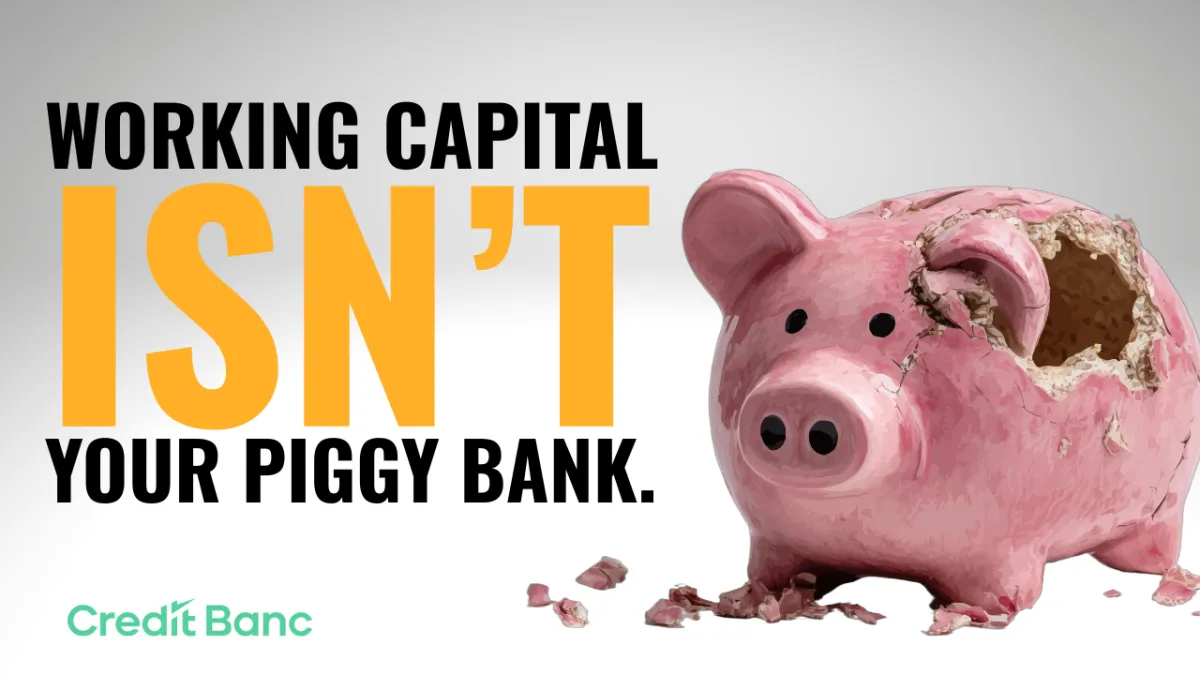
Stop Using Working Capital Like a Piggy Bank
Let’s have a mildly uncomfortable conversation.
If you’re pulling $150K–$500K straight out of your operating cash to buy equipment, and then high-fiving yourself for “not taking on debt,” we need to talk.
Because working capital is not your piggy bank.
It’s oxygen.
And suffocating your own business to avoid financing is not conservative. It’s expensive.
For small and medium-sized businesses, equipment financing isn’t about being flashy. It’s about protecting cash flow, maintaining liquidity, and aligning capital with revenue generation.
Let’s break this down strategically. With numbers.
1. Working Capital Is for Operations, Not Ego
Working capital exists to:
Cover payroll
Fund inventory
Handle seasonal slowdowns
Manage receivables gaps
Absorb unexpected expenses
When you drain that cushion to buy a machine in cash, you’re not being disciplined. You’re shrinking your margin for error.
Cash flow management is one of the biggest challenges for growing businesses, and preserving liquidity isn’t optional. It’s survival.
Equipment financing allows you to preserve working capital while still acquiring the assets that drive revenue.
That’s strategic. Not reckless.
2. Cash Purchases Create Invisible Risk
Let’s say you buy a $250,000 piece of equipment outright.
Feels good, right?
Now let’s fast-forward three months:
A large client pays late
A new hire ramps slower than expected
Insurance premiums jump
You land a bigger job that requires more upfront material
Suddenly, your cash cushion is thinner than your patience.
This is where businesses get reactive:
Short-term loans
High-cost capital
Delayed payroll decisions
Frozen growth plans
The irony? The “safe” move created more risk. With 100% equipment financing, you maintain liquidity while the asset produces revenue.
Debt isn’t the risk. Illiquidity is.
3. If the Equipment Generates Revenue, It Should Pay for Itself
Here’s the strategic lens: If a machine increases output, reduces labor cost, or allows you to bid larger contracts, it’s not an expense.
It’s a revenue-generating asset.
Which means: It should be structured in a way that matches its revenue timeline.
This is where extended terms up to 84 months matter.
Instead of taking a massive cash hit upfront, you align:
Monthly payment
Revenue generation
Asset lifespan
That’s financial alignment. And alignment is how you scale without panic.
4. Opportunity Cost Is Real (Even If You Ignore It)
Let’s say you have $300,000 sitting in the bank, and you spend it on equipment.
Now you can’t:
Launch a marketing campaign
Hire a key operator
Take advantage of a supplier discount
Acquire a competitor
Cover a sudden working capital gap
That’s opportunity cost.
Strategic use of equipment loans up to $5 million allows you to deploy capital across multiple growth initiatives instead of locking it into one asset.
Liquidity = options.
Options = leverage.
5. “Debt-Free” Isn’t a Strategy. It’s a Preference.
Healthy businesses use leverage strategically.
They:
Finance assets with predictable ROI
Protect cash reserves
Match debt terms to asset lifespan
Maintain flexibility
Avoiding equipment financing purely to avoid debt can actually slow business growth.
You don’t win awards for “least leveraged.” You win by allocating capital intelligently.
6. Speed Matters More Than You Think
Growth windows close.
Contracts get awarded.
Competitors upgrade.
Demand shifts.
Waiting 60–90 days for traditional bank approvals can cost you deals.
With streamlined equipment financing approvals in as little as 24 hours, businesses can act quickly when opportunity shows up.
For loans under $150,000, the application-only process simplifies access without tax returns or full financial packages.
Speed + structure = momentum.
7. Startups Can’t Afford to Wait
One of the biggest myths in small business financing is, “You need years in business to qualify.”
Not always.
Modern equipment financing solutions often allow:
No minimum time in business
New or used equipment
100% financing options
If your startup is revenue-generating but under-equipped, waiting years to upgrade can cap growth before it starts.
8. Used Equipment Isn’t Second-Class
Some business owners assume financing only makes sense for new equipment.
Wrong.
Financing applies to:
Heavy machinery
Construction equipment
Manufacturing tools
Medical equipment
Commercial vehicles
Technology upgrades
New or used equipment financing allows businesses to upgrade intelligently without draining reserves. The asset just needs to produce value.
9. Equipment Bottlenecks Kill Scaling
Let’s zoom out.
Most stalled growth isn’t a demand problem. It’s a capacity problem.
You can’t:
Increase production
Reduce turnaround time
Improve quality
Expand service offerings
…if your equipment is outdated or maxed out.
Smart small business owners view equipment financing as infrastructure expansion…NOT as a burden.
10. Cash Flow Is King. But Structure Is the Crown.
If you remember nothing else, remember this:
Cash flow is oxygen.
Structure is the system that keeps it circulating.
Equipment financing protects working capital.
It aligns payments with revenue.
It preserves flexibility.
It allows you to grow without gambling your liquidity.
And no one ever scaled a serious business by hoarding cash and under-investing in capacity.
Final Thought
We implore you! Stop treating working capital like a savings account for big purchases.
It’s not a piggy bank.
It’s your safety net, growth engine, and operating cushion all rolled into one.
Use equipment financing strategically.
Preserve liquidity.
Match payments to production.
Keep your options open.
Because the goal isn’t to avoid debt. The goal is to build a business strong enough that debt works for you instead of against you.
And that starts with respecting your working capital like the asset it actually is.
If you’re thinking about upgrading equipment and want to run the numbers before touching your cash reserves, CLICK HERE to book a quick call with our team. We’ll help you structure it the smart way.
