
The Summer Payroll Crunch: When Busy Season Hits Before the Bank Account Catches Up
SUMMER BUSINESS BOOMING? CUTE. NOW MAKE PAYROLL.
Summer growth sounds great until payroll shows up and ruins the party.
More customers. More jobs. More booked work. More demand.
Excellent.
Now you need more people, more hours, more overtime, more seasonal help, more contractors, and more cash going out before the revenue actually lands.
That is where busy season gets dangerous.
Not because sales are weak.
Not because the business is failing.
Not because demand disappeared.
Because payroll often grows before the bank account catches up.
In our last post, Why Summer Growth Can Create a Cash Crunch Before the Revenue Lands, we talked about the bigger summer cash flow gap: growth usually costs money before it makes money. Payroll is one of the fastest ways that gap gets ugly.
Because employees do not accept “the invoices are out” as payment. (Rude, but fair.)

What Is a Summer Payroll Crunch?
A summer payroll crunch happens when labor costs increase before cash comes in.
That may mean:
Hiring seasonal employees
Increasing staff hours
Covering overtime
Adding crews
Paying contractors or subcontractors
Training new employees
Staffing longer days, weekends, or peak-season demand
The business may be doing well. The work may be booked. Revenue may be on the way.
But payroll is due now.
That timing gap is the problem.
A restaurant may need more servers and kitchen staff before the month’s sales settle. A contractor may need labor on-site before the next draw or invoice payment. A landscaper may need extra crews before customer payments come in. An event company may need staff before final balances clear.
The business is busy.
The cash is not always caught up.
That is small business cash flow in the summer: good news on the calendar, pressure in the account.
Why Payroll Gets Heavy Before Revenue Lands
Payroll moves fast.
Revenue often does not.
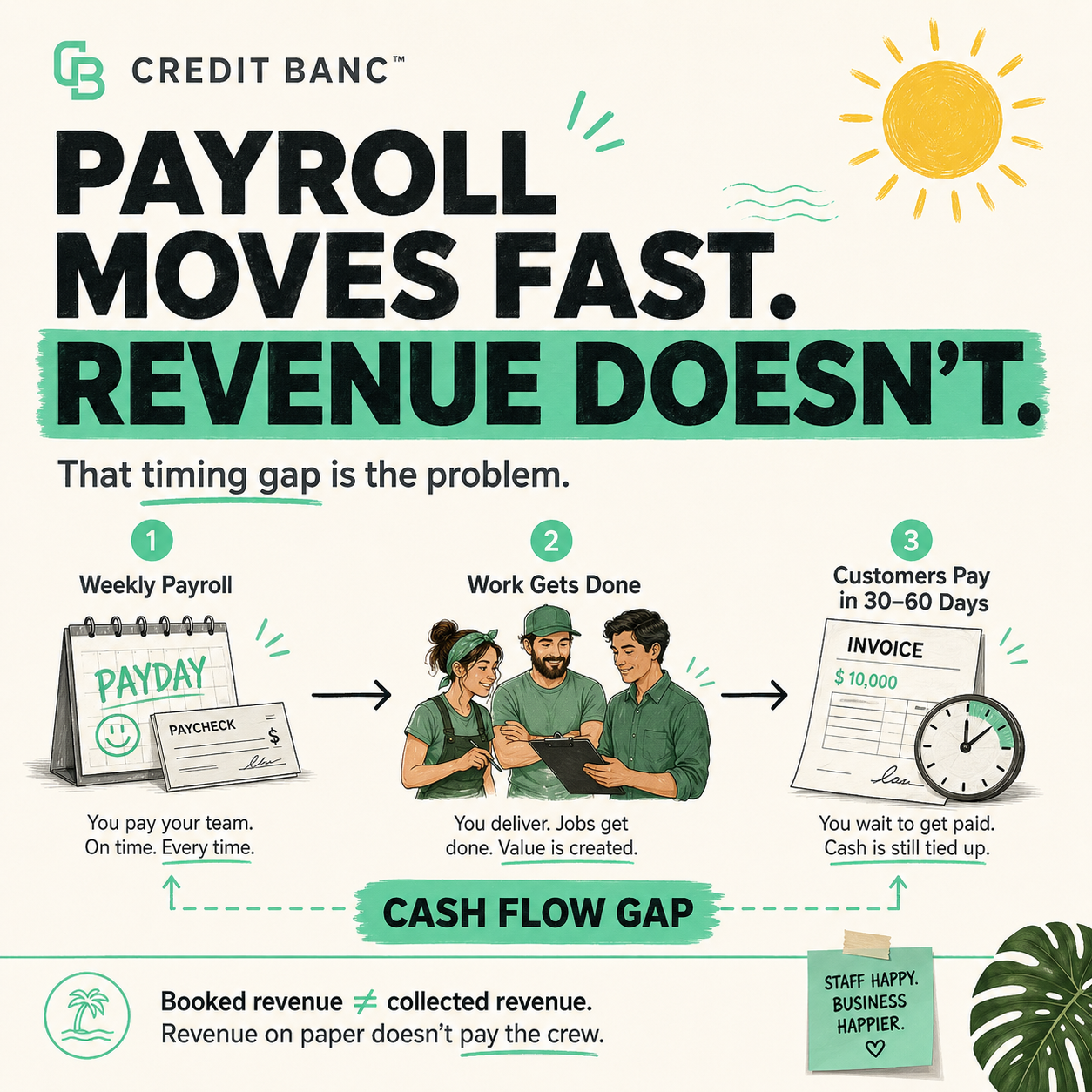
Employees may need to be paid weekly or biweekly. Customers may pay in 30, 45, or 60 days. Project payments may depend on milestones. Insurance reimbursements may take time. Commercial clients may pay whenever their accounting department emerges from its windowless cave and blesses the invoice.
Meanwhile, your people still need to be paid.
This is why more business does not automatically mean more available cash.
Booked revenue is not collected revenue.
A signed contract does not make payroll.
An unpaid invoice does not cover overtime.
A busy calendar does not mean the account is ready.
This is where owners get squeezed. The business looks strong on paper, but the timing is off. Payroll goes out before the money comes back in.
That is a cash flow gap.
And if you do not plan for it, you may end up grabbing the fastest funding available instead of the funding that actually fits.
That gets expensive fast.
Who Feels the Payroll Crunch Most?
Any business with rising labor costs and delayed cash can feel it, but summer makes the problem especially common for:
Restaurants and hospitality businesses
Contractors and home service companies
Landscapers and outdoor service businesses
Event companies
Retailers with seasonal staffing
Gyms, camps, and recreation businesses
Medical, dental, and wellness practices
Cleaning companies and facilities services
Transportation and logistics businesses
For contractors, this can be especially sharp. A bigger job may require crews, subcontractors, materials, fuel, and equipment before payment comes in. That is why business funding for contractors is often less about whether the work exists and more about whether the business can carry the cost of doing the work.
Same problem, different work boots.
The Payroll Timing Problem
The danger with payroll is that it is recurring, predictable, and completely uninterested in your excuses.
If payroll is due every Friday and your customers pay 30 days later, your business has to carry that gap.
If summer demand pushes payroll higher, the gap gets wider.
If overtime becomes normal, the gap gets even wider.
If one late customer payment can make payroll stressful, the business is already too close to the edge.
That does not mean you are doing something wrong. Plenty of strong businesses deal with payroll pressure during busy seasons.
But it does mean you need to look at the numbers before payroll week shows up with a bat.
This is where the Cash Flow Gap Calculator can help. Use it before you hire, extend hours, add crews, or say yes to more work that requires more labor upfront.
The question is not just, “Can we handle the work?”
The better question is:
Can we afford to deliver the work before the revenue lands?
Less fun. More useful.
When Business Funding for Payroll May Make Sense
Business funding for payroll should not be treated like free money with better lighting.
Borrowing to cover payroll can help in the right situation. It can also create a bigger problem if the repayment terms do not match the business.
Funding may make sense when:
You have receivables coming in, but payroll is due first
You need seasonal staff before peak revenue hits
You won a project that requires labor upfront
You need temporary working capital to cover a timing gap
You have strong demand but need breathing room to deliver the work
You are covering funding for summer business expenses while waiting for revenue to catch up
The key word is temporary.
Funding should bridge the gap between payroll going out and revenue coming in. It should not turn every future week into a repayment hangover.
This is why structure matters.
A fast approval is not automatically a smart approval. Sometimes it is useful. Sometimes it is just expensive money wearing a clean shirt.
Working Capital Loan vs. Business Line of Credit
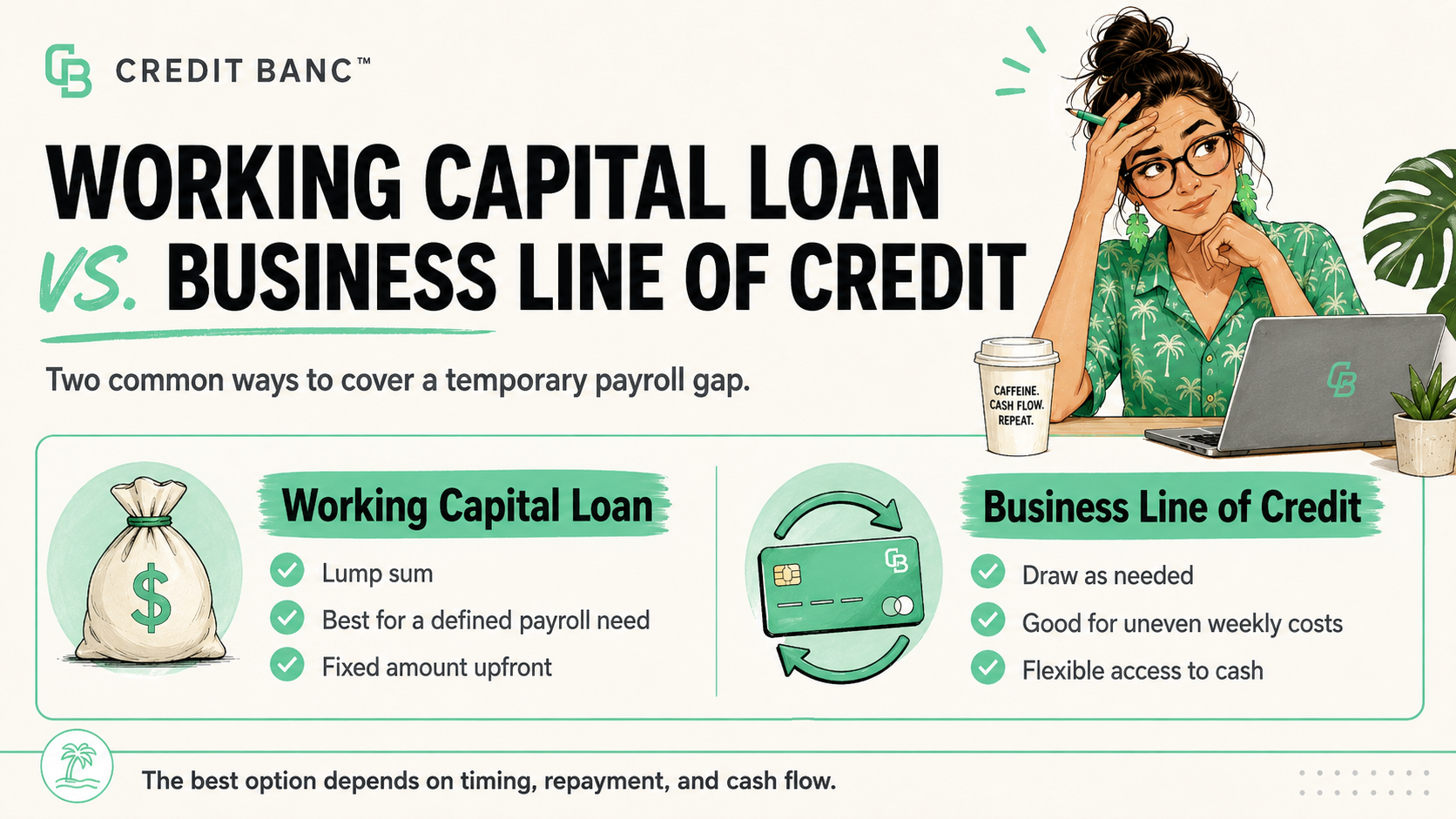
Two common small business funding options for payroll pressure are a working capital loan and a business line of credit.
They are not the same thing.
A working capital loan is usually a lump sum used to cover operating expenses. That may include payroll, seasonal staff, overtime, contractors, vendor bills, rent, supplies, or other short-term costs.
This can make sense when you know roughly how much cash you need and how long the gap will last.
A business line of credit gives you access to funds as needed. You can draw when expenses spike and repay as cash comes in.
This can make sense when payroll needs are less predictable or when seasonal demand comes in waves.
Common business line of credit requirements may include time in business, revenue, personal credit, bank statements, business cash flow, current debt, and overall financial health. Requirements vary by lender, because apparently one simple answer would have been too generous.
Neither option is automatically better.
The better option depends on:
How much cash you need
When payroll is due
When revenue is expected to land
How long the gap will last
Whether receivables are reliable
What repayment schedule the business can handle
Existing debt
Revenue trends
Credit profile
This is where a funding review helps.
The question is not, “Can I get approved?”
The better question is, “Can my business actually live with this repayment schedule after payroll is covered?”
That second question saves people from some expensive nonsense.
What About a Business Cash Flow Loan?
A business cash flow loan may also be part of the conversation when the issue is timing.
This type of funding is generally used to support operating expenses when cash coming in and cash going out are not lining up neatly. Payroll is a common example.
But again, the point is fit.
If the business has a short-term payroll gap because revenue is coming in two or three weeks later, the funding should reflect that. If the business has a deeper margin problem, adding debt may only hide the issue for a minute before it comes back with friends.
That is why the calculator and the conversation matter.
Use the Cash Flow Gap Calculator to get a clearer view of what is coming in, what is going out, and whether the issue looks temporary, manageable, or already wearing a villain cape.
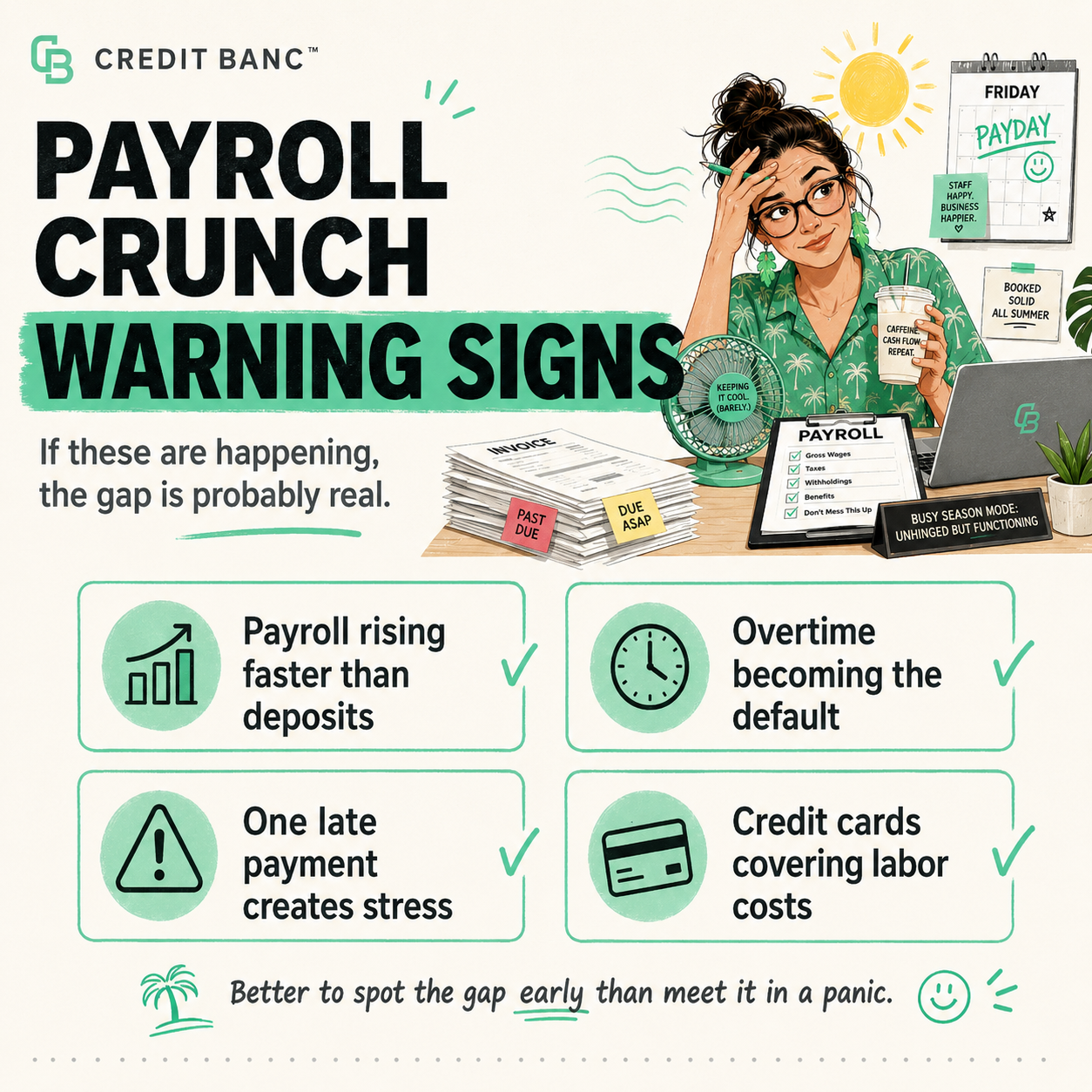
Payroll Crunch Warning Signs
A payroll crunch usually sends warnings before it becomes a full fire drill.
Watch for these:
Payroll is growing faster than deposits
If labor costs are rising faster than cash deposits, pay attention. Sales may be up, but cash may still be behind.
Overtime is becoming the default
Overtime can help during busy season. But if it becomes the operating model, margins can start bleeding quietly.
You are hiring before reviewing payment timing
More work may require more people, but weak payment terms can turn a good opportunity into a cash problem.
Payroll depends on one customer payment arriving on time
That is not a plan. That is a coin toss with direct deposit attached.
You are delaying vendors to cover payroll
This may solve Friday’s problem and create next week’s problem.
You are using credit cards to cover recurring labor-related expenses
That can work for a minute. Then the interest shows up and makes itself comfortable.
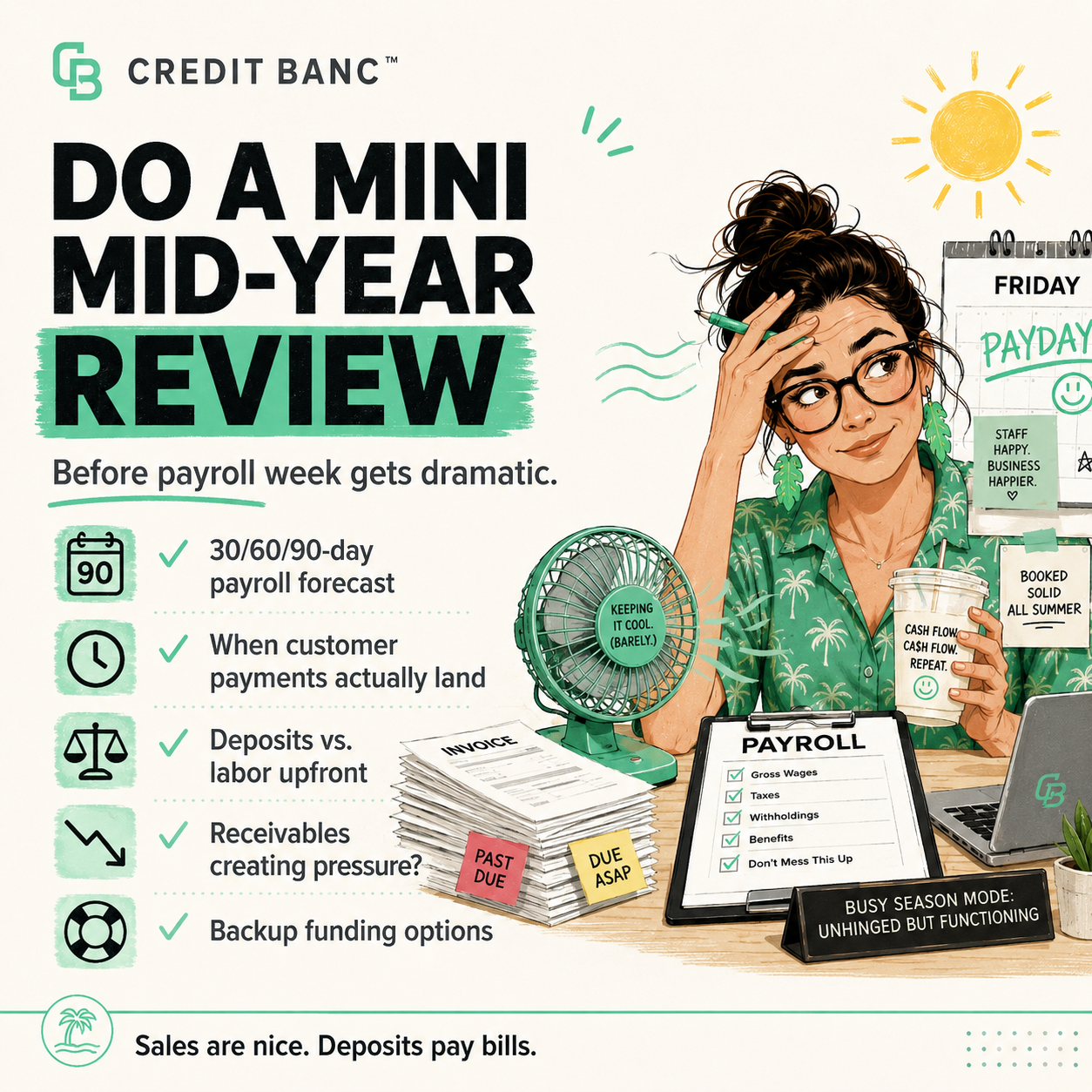
You have no backup funding option
Waiting until payroll week to look for capital limits your choices. That is when business owners often take the fastest offer, not the best fit.
If any of these are already happening, run the numbers through the Cash Flow Gap Calculator. It is better to see the gap early than meet it in a panic.
Do a Mini Mid-Year Business Review Before Payroll Gets Ugly
The fix is not always funding. Sometimes the fix is better billing, stronger deposits, faster collections, tighter scheduling, or smarter staffing.
A mid-year business review does not need to be dramatic. You don’t need a boardroom, a dashboard, or someone named Greg saying “circle back.”
You just need to answer a few practical questions.
What will payroll look like over the next 30, 60, and 90 days?
Include new hires, overtime, seasonal staff, contractors, commissions, and payroll taxes.
When will customer payments actually arrive?
Look at collections, not sales. Sales are nice. Deposits pay bills.
Are deposits covering enough upfront labor?
If your deposit does not cover the labor needed to start the work, your business is financing the customer.
Can payment terms be improved?
Earlier deposits, progress billing, shorter invoice terms, and clearer payment milestones can reduce the gap.
Are receivables creating pressure?
If invoices are sitting unpaid while payroll keeps going out, you may have an accounts receivable cash flow gap. That does not mean the revenue is fake. It means the timing is a problem.
What happens if revenue arrives two weeks late?
This is the question that separates “we’re fine” from “we have a problem.”
If a late payment would make payroll difficult, you have a cash flow gap worth planning for.
This is also where a cash flow forecast for small business owners can help. It does not need to be fancy. It needs to show what cash is expected, what expenses are coming, and where the timing may get tight.
Why Waiting Until Payroll Week Gets Expensive
The closer you get to payroll with too little cash, the fewer good options you usually have.
That is when speed starts looking very attractive.
Fast approval. Minimal paperwork. Money tomorrow.
Sometimes fast funding is useful. But speed alone is not the strategy.
As we covered in Why Summer Growth Can Create a Cash Crunch Before the Revenue Lands, needing money quickly does not automatically mean the most aggressive option is the only option. The problem is waiting until the situation feels urgent and then assuming whatever shows up first is the answer.
That is how a temporary cash flow gap turns into a longer-term repayment problem.
Daily or weekly repayment may not fit a seasonal payroll gap. A short repayment window may not fit slow-paying receivables. A quick fix may create pressure long after the payroll issue is gone.
The goal is not just to make payroll this week.
The goal is to make payroll without punishing the next several months of cash flow.
Important distinction. Expensive to ignore.
What Funding Options May Help?
The right funding depends on your business, timing, revenue, receivables, debt, and repayment ability.
A few options may be worth reviewing:
Working Capital Loan
A working capital loan may help cover payroll, seasonal staff, overtime, contractors, or operating expenses during a temporary cash flow gap.
Business Line of Credit
A business line of credit may help when payroll needs fluctuate. You can access funds when needed instead of borrowing one larger lump sum upfront.
Seasonal Business Financing
Seasonal business financing may help businesses that see predictable increases in labor costs before revenue catches up.
This can apply to restaurants, contractors, landscapers, event companies, hospitality businesses, gyms, retailers, service businesses, and plenty of other operators who get busier before they get paid.
Receivables-Based Options
If the issue is slow-paying customers or outstanding invoices, a receivables-based option may help bridge the gap between completed work and collected cash.
Short-Term Funding
Short-term funding may help in some cases, but terms matter. A short-term fix should not create a longer-term cash problem.
Other Use-Specific Funding
Payroll may be the issue this week, but it may not be the only summer expense putting pressure on cash.
If the real need is stocking up before sales hit, inventory financing for small business may be a better fit. If the problem is a truck, tool, machine, kitchen system, or other operating asset, equipment financing for small business may deserve a closer look.
Do not use one generic loan for every problem just because it showed up first and smiled.
The funding should match the gap. Not the panic.
Payroll Growth Is Not the Problem
Needing more people can be a good sign.
It means demand is there. Customers are showing up. Work is available. The business has opportunity.
The problem is when payroll grows faster than the cash flow plan.
That happens when owners add labor without checking margins, deposits, payment terms, receivables, or available working capital.
Growth should move the business forward. It should not leave you wondering why being busier somehow made you broke.

Don’t Let Payroll Turn Busy Season Into a Cash Flow Mess
Moral of the story? Summer growth can be great. But if payroll gets heavier before cash catches up, the business can feel squeezed even while sales are strong.
That is the summer payroll crunch.
Before you add staff, approve overtime, bring on contractors, or stretch your team across more work, look at your payroll timing, receivables, projected revenue, and available cash.
Start with the Cash Flow Gap Calculator to see whether a gap may be forming.
Then, if the numbers show pressure, book a call here with Credit Banc to review small business funding options that may fit the actual timing of your business.
Because making payroll matters.
Making payroll with funding that screws you over for the next three months?
Not on our watch.
